

 Property Search
 Report maintenance
 Renters’ Rights Act Phase 2: Key Changes for Landlords
The first phase of the Renters’ Rights Act came into force on 1st May 2026, bringing some of the biggest changes to the private rented sector in years. Section 21 is gone, fixed-term tenancies now follow the new periodic system, and landlords and agents already have plenty to manage.
But there’s more to come.
Attention is now turning to Phase 2, which will introduce two more significant changes for landlords: the new Private Rented Sector Database and a mandatory Landlord Ombudsman.
Neither is in force just yet, and there are still some details we’re waiting for. But we now have a much clearer idea of what’s coming, when it’s likely to happen, and what landlords can start doing now to prepare.

When will Phase 2 start?
The Government plans to begin the first stage of Phase 2 in late 2026. However, the Government has not confirmed a start date.
Unlike the tenancy reforms in May, the new PRS Database won’t simply go live across England on the same day. The plan is to introduce it gradually, region by region.
Landlords in our area should have more notice before registering. We expect further Government guidance as the rollout gets closer.
For now, there’s nothing landlords need to register for. But it’s worth knowing what information you may need to provide.
What Is the New PRS Database?
The Government is creating a national database covering private landlords and their properties in England.
Once introduced, all landlords will need to register.
Landlords will need to provide information about themselves and each property they let. Current guidance suggests this will include:
- Landlord contact details, including details for joint landlords where applicable
- The property address and property type
- Number of bedrooms and information about its occupancy
- Whether you let the property furnished or unfurnished
- Gas Safety Certificate
- Electrical Installation Condition Report (EICR)
- Energy Performance Certificate (EPC)
There will also be an annual registration fee, although we don’t yet know how much that will be.
The database will eventually contain information about enforcement action too, including banning orders, convictions and other regulatory penalties.
Every Landlord and Property Will Have an ID
Once registered, landlords and individual properties will each receive a unique identifier.
This will be particularly important when marketing properties, as advertisements will need to include the relevant registration details.
Letting agents will also need to check that landlords and their properties are correctly registered before marketing them.
So, once the rules are in force, registration won’t just be another piece of paperwork. It will become part of being able to legally advertise and let a property.
What Happens If a Landlord Doesn’t Register?
This is where the new system has some teeth.
Landlords could face a civil penalty of up to £7,000 for failing to register or advertising an unregistered property.
For repeated breaches or deliberately providing false or misleading information, penalties can rise to £40,000, with criminal prosecution also possible.
There’s another important consequence too.
Landlords who fail to register may be unable to obtain a possession order until they meet the registration requirements. Limited exceptions apply, including certain anti-social behaviour grounds. This makes registration an important part of your compliance checklist.
What About the New Landlord Ombudsman?
The other big part of Phase 2 is the introduction of a mandatory PRS Landlord Ombudsman.
The idea is to give tenants access to an independent complaints and dispute-resolution service without having to take a landlord to court.
Importantly, the Government plans to introduce the Ombudsman separately from the PRS Database.
The Government wants the two systems to work together, which should reduce the amount of duplicate registration and administration landlords have to deal with.
The first step will be appointing the organisation that will run the scheme. The Government currently expects to make Ombudsman membership mandatory for all landlords in 2028, once the service is ready.
Landlords will have to pay an annual fee to fund the Ombudsman, although, again, we don’t yet know what that fee will be.
Once membership becomes compulsory, failing to join could lead to civil penalties of up to £7,000, rising to £40,000 or prosecution for repeated breaches.
In Practical Terms, What Should Landlords Do Now?
There isn’t an application form to fill in yet, and there isn’t a registration deadline to put in the diary.
So there’s no need to panic about Phase 2. But there are a few sensible things worth doing now.
Make sure your compliance paperwork is in order. Keep your Gas Safety Certificates, EPCs and EICRs current and easy to access, as you’ll likely need them when registering.
Keep an eye on expiry dates. Once the database is operating, staying on top of certificate renewals is likely to become even more important. A good compliance tracking system now will save headaches later.
Keep good property records. Clear records of maintenance reports, repairs and tenant communication will help you respond effectively if a tenant escalates a complaint.
And finally, don’t rush to register for anything yet. The Government is still developing the detailed regulations and guidance, so some practical requirements may change before launch.
Do We Manage Your Property?
If we fully manage your property, this is exactly the kind of regulatory change we’ll be keeping on top of for you.
We’re monitoring Phase 2 and will advise landlords once the Government confirms the registration process for our region.
In the meantime, we already hold and monitor much of the property compliance documentation expected to be required as part of the new database, including safety certificates and tenancy records.
If you self-manage properties outside our service, now is a good opportunity to check that your records are complete and that you have a reliable way of monitoring renewal dates.
What Happens Next?
There are still a few important gaps in the detail.
The Government hasn’t confirmed the PRS Database launch date, annual registration fee, or final charging structure for the Ombudsman.
What we do know is the direction things are heading: mandatory registration, mandatory redress and much greater visibility of landlord and property compliance.
For now, we’d treat late 2026 as the point to be ready for, rather than a deadline to do anything immediately.
We’ll keep you updated as soon as the Government confirms the next stage of the rollout.
If you’re a landlord and you’re unsure whether your current compliance records are ready for the changes ahead, we’re always happy to have a conversation.


Will you be fined £30,000?
The latest Minimum Energy Efficiency Standards (MEES) mean that landlords in England and Wales must ensure all private rental properties reach a minimum EPC rating of Band C by 1st October 2030. Any that don’t meet this could be fined up to £30,000 by their local council.
2030 may seem far away, but it takes time to plan and install what’s needed. So, if you want to avoid the fines, it’s best to get started now. And the best place to start is an Energy Efficiency Plan from Retrofit West. Prices start at £80 per property and include a FREE EPC.
A Landlord Energy Efficiency Plan will tell you exactly what your property needs to reach EPC C, in what order and what it’ll cost. As well as, how to navigate compliance, cost caps and exemptions.
Free advice is always available first, so we can talk through what you need.

This article provides general information based on our understanding of the Renters’ Rights Act and implementation plans. It does not constitute legal or professional advice. Requirements may change as further regulations and Government guidance are published.

EPC Update: What’s Been Confirmed for 2030
The regulations governing Energy Performance Certificates have recently been clarified, and enough specifics are now available to merit a closer look at what’s actually changing. Below, we outline what’s been confirmed, what it means for your property, and some steps to consider.

What’s Been Confirmed
From 1 October 2030, most privately rented homes will need to reach the equivalent of EPC Band C. This applies to all tenancies from a single date, rather than the phased approach (new tenancies first, then existing ones) that was originally proposed. If your property already holds a valid EPC C before 1 October 2029, it will generally be treated as compliant until that certificate expires.
The bigger change is how compliance will actually be measured. Rather than one overall rating, landlords will need to meet a dual-metric standard: a Fabric Performance metric covering insulation, windows and airtightness, plus a second metric of their choosing, either Heating System or Smart Readiness. In practice, the fabric of the property has to be addressed first, before heating upgrades or smart technology can count towards compliance.
Why This Matters for Your Property
A lot of Bristol’s older terraces, converted flats and solid-wall properties currently sit within EPC Bands D and E. The good news is that the improvements which move a property from D to C are often more straightforward than landlords expect:
- Loft and wall insulation
- Upgraded glazing and draught-proofing
- Heating controls and boiler upgrades
- LED lighting throughout
Most of this can be carried out with tenants in place, without the need for a full renovation.
A New Way of Measuring EPCs
The Government is also replacing the current EPC system with a new methodology called the Home Energy Model (HEM). HEM is expected to begin in the second half of 2027 and will run alongside the existing assessment method for a transitional period. From October 2029, all newly issued EPCs are expected to use HEM.
Importantly, EPCs are valid for 10 years. This means that if your property already holds a valid EPC rated C before 1 October 2029, it is expected to remain compliant under the proposed rules until that certificate expires, even after HEM is introduced.
However, a property that achieves a C rating under today’s methodology may not necessarily achieve the same rating under HEM. If you’re already considering improvements, acting sooner could provide greater certainty before the new assessment framework comes into force.
In Practical Terms
- Landlords will only be required to spend up to £10,000 per property over a ten-year period to meet the standard. This is a compliance cost cap rather than a limit on what you can spend. If eligible improvements costing up to £10,000 have been completed and the property still cannot achieve the equivalent of EPC C, an exemption can be registered.
- The Government’s own impact assessment estimates that the average cost of compliance is likely to be around £5,400 per property.
- The exemptions available have been widened, including a new “negative impact” exemption for cases where measures such as solid wall insulation could damage the property or adversely affect its fabric.
- Local authorities will have stronger enforcement powers, with fines of up to £30,000 per breach for non-compliant properties.
It Doesn’t Stop at EPCs
These changes aren’t happening in isolation. The Renters’ Rights Act is also raising expectations around housing quality, with stricter requirements for tackling issues like damp and mould. Energy efficiency improvements often address both agendas at once, helping you stay ahead of compliance while keeping tenants happier and reducing void periods.
Are you exempt from reaching EPC C?
Not every rental property can reach EPC C, and that’s fine, as long as it’s documented properly.
If you’ve hit the cost cap, made all the improvements that are technically possible, or your property has genuine limitations, you may qualify for an exemption rather than completing further work.
You need to check what exemptions you’re eligible for and make sure you have evidence. Your first rental property could even be free.
Retrofit West’s Landlord Energy Efficiency Plan, from £80, tells you whether your property is heading for an EPC C rating or a valid exemption, and what proof you’ll need in either case. It includes a new EPC and another once you’ve done any works.
Free advice is available first if you’d rather talk it through.
This article is for general information only and reflects our understanding of relevant legislation at the time of writing. It does not constitute legal or professional advice. As landlord obligations vary by circumstance, we recommend seeking independent advice where appropriate.
June Newsletter – Quarterly Rental Market Review
This edition covers the key trends shaping Bristol’s rental market as we move through 2026. From how tenant demand and available stock have evolved, to where rents are settling after last summer’s peak. We also explore the journey to EPC C compliance, with expert insight from Retrofit West, showing why many landlords may find meeting the 2030 deadline simpler than they expect.

Quarterly Market Review
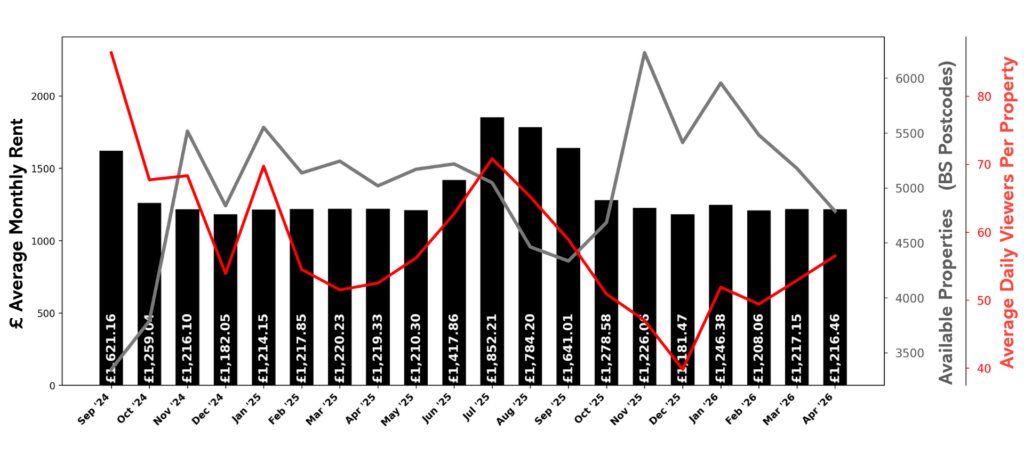
Over the past six months, Bristol’s rental market has shifted into a more balanced position. Following a particularly busy summer in 2025, tenant demand eased towards the end of the year as more properties became available. However, activity has steadily recovered during spring 2026, with average daily views per property rising from 39.8 in December to 56.5 by April. While renters now have more choice, demand remains resilient, particularly for well-presented homes in desirable locations.
Property availability reached its highest level in late 2025, with more than 6,000 homes on the market, before easing slightly into the new year. Compared with this time last year, landlords are operating in a more competitive environment, making accurate pricing and strong marketing more important than ever.
Rental prices in the South West have also begun to stabilise. After reaching a peak of £1,852 in July 2025, average monthly rents settled at around £1,220 through winter and spring. This suggests the exceptional rental growth seen during the supply shortage has moderated as stock levels have improved. However, affordability continues to influence tenant decisions.
What’s Next for Bristol Landlords
Over the next six months, we expect Bristol’s rental market to remain healthy, but increasingly competitive. Demand is likely to stay strong thanks to the city’s growing population, universities and employment opportunities. Although tenants will continue to have more choice than they did in recent years.
For landlords, this means the focus is shifting away from simply listing a property and waiting for enquiries. Success will depend on presenting properties to a high standard, setting realistic rents and attracting the right tenants from the outset. Homes that are well maintained, professionally marketed and competitively priced are expected to let quickly, while overpriced or poorly presented properties may take longer to secure tenants.
At The Letting Game, we help landlords adapt to changing market conditions. We combine expert pricing advice, professional marketing and targeted tenant matching to minimise void periods and maximise long-term returns.
Want free help bringing your rental up to EPC C?
Here’s something most landlords don’t realise. For a lot of Bristol’s older rental properties, the gap between EPC D and EPC C doesn’t require a disruptive renovation.
The improvements that make the biggest difference are often simple ones:
-
Changing to LED lighting
-
Draught-proofing gaps around windows and doors
-
Adding heating controls
-
Loft insulation
-
Wall insulation
-
A boiler upgrade

All of these can be done with tenants in place. From 2030, rental properties need to reach EPC C to remain compliant, but for many landlords the path to getting there is a lot less disruptive than they’re expecting.
What you actually need is a personalised roadmap to EPC C for your specific property.
Retrofit West is a not-for-profit advice service for landlords in the West of England. Starting from £80, their Landlord Energy Efficiency Plan’s will tell you exactly what your property needs to reach EPC C, in what order, what it’ll cost, and how to navigate compliance, cost caps and exemptions. The plan includes a new EPC and a free one again once the work is done, so your compliance is documented.
Free advice is available first if you want to talk it through.
Landlord Update: May 2026
It’s been a busy month behind the scenes, and in this landlord update we’re covering several important changes affecting landlords right now. Between new legal obligations landing and an important tribunal ruling making headlines, there’s a fair bit to be aware of. Here’s what’s happened, what we’ve already handled for you, and what you should know.

Government Information Sheet Update for Managed Landlords
The Renters’ Rights Act 2025 introduced a requirement for landlords to share an official Government Information Sheet with all existing tenants before 31st May 2026. It covers things like how the new periodic tenancy system works, how rent increases are handled, the pet request process, and how possession now works without Section 21.
Do we manage your property?
If we manage your property, you don’t need to do a thing – we’ve already taken care of it. We distributed the Government Information Sheet to all tenants by email on 7th May 2026, and posted a hard copy, well ahead of the 31st May deadline.
Or do you self-manage?
If you self-manage any properties outside of our service (our let-only landlords), you’ll need to arrange this yourself before the 31st May 2026 deadline. The information sheet needs to go to every existing tenant via email, post, or in person — and it’s a good idea to keep a note of when and how it was sent, just in case it’s ever queried. You can find the official Government Information Sheet here. Please note, if you are sending the Government Information Sheet to your tenants via email, the sheet must be sent as an attachment. Simply sharing a link to it is not sufficient to meet the requirement.
If you have any questions about the process or what it means for your tenancy, we’re always happy to have a conversation.

What the Renters’ Rights Act Means for Deposit Disputes
A lot of the conversation around the Act has focused on tenancy reform and the end of Section 21. But its impact on deposit disputes is just as significant, and it’s worth making sure you’re on the right side of it.
Here’s the key shift: with all tenancies now rolling rather than fixed term, a tenancy that might once have run for a year could now go on for several years. That means the condition evidence you gather at the start of a tenancy needs to hold up for much longer.
In Practical Terms
- A detailed move-in inventory with photographs is more important than ever
- Mid-tenancy inspection records help build a clear picture of the property’s condition over time
- Good records of repair requests and how they were handled can make or break a deduction at dispute stage
- Fair wear and tear still can’t be deducted — that hasn’t changed, but it’s being looked at more closely
- And worth knowing: a possession order can’t be granted if the deposit isn’t protected in a government-approved scheme
Deposit Considerations
If a tenant reports a hazard like damp or disrepair and it isn’t dealt with, that can affect your ability to make deductions at the end of the tenancy. Staying on top of maintenance isn’t just good practice – it’s increasingly tied to your legal and financial position.
For managed properties, we hold your inspection records and inventory documentation as standard, so if a deposit dispute ever lands on your doorstep, you’re not scrambling to pull evidence together at short notice. Your move-in inventory, inspection photographs, and maintenance correspondence are all logged and kept on file throughout the tenancy. It’s one of those things that rarely feels urgent until it suddenly is, and we’d rather you’re well covered long before it gets to that point.
A Tribunal Ruling Every HMO Landlord Should Know About
A recent Upper Tribunal decision has been doing the rounds in the industry, and it’s worth paying attention to. Especially if you own an HMO or have appointed a management company.
- Here’s what happened. A landlord handed management of her property to a management company under an agreement that paid her a fixed monthly sum of £3,400. The agreement explicitly said the property wasn’t to be used as an HMO. The management company ignored that and let it as one anyway, collecting between £7,000 and £10,000 per month from tenants. When the HMO licence expired and wasn’t renewed, the council issued financial penalties of more than £20,000.
- The landlord was ultimately cleared because the Tribunal ruled that the management company, not the owner, was in control of the property. The outcome was positive, but it was far closer to a disaster than it should have been.

A Few Things Every HMO Landlord Should Take from This:
- A management agreement without clear terms about permitted use offers you very little protection
- HMO licences can expire without you knowing if your oversight arrangements aren’t tight enough
- Civil penalties for unlicensed HMOs can reach £30,000 per offence — and there’s no cap in criminal proceedings
- Tenants or local authorities can also seek Rent Repayment Orders covering up to 12 months’ rent
Do you own an HMO? How confident are you in your current arrangements? We proactively monitor licences for all HMOs we manage. It’s just one of the ways we protect our landlords. If you’d like to talk through what this looks like in practice, we’re always happy to have a conversation.
This article is for general information only and reflects our understanding of relevant legislation at the time of writing. It does not constitute legal or professional advice. As landlord obligations vary by circumstance, we recommend seeking independent advice where appropriate.